
The EB-5 Immigrant Investor Program is one of the most compelling pathways to U.S. permanent residency for high-net-worth individuals. There are many EB-5 projects available, but they are not all created equal.
The immigration outcome depends on the quality of the investment behind it. In a market where many projects carry significant construction, execution, or market risk, finding one that combines genuine capital protection with immigration efficiency is rarer than it sounds.
Cairnspring Mills Rural EB-5 Project is one of those rare finds. It's an established, revenue-generating American food manufacturer backed by institutional investors, supported by blue-chip customers, and structured to deliver both immigration security and meaningful investment protection.
Read on to find out exactly what sets this project apart and why you should consider investing in it.
About Cairnspring Mills Rural EB-5 Project
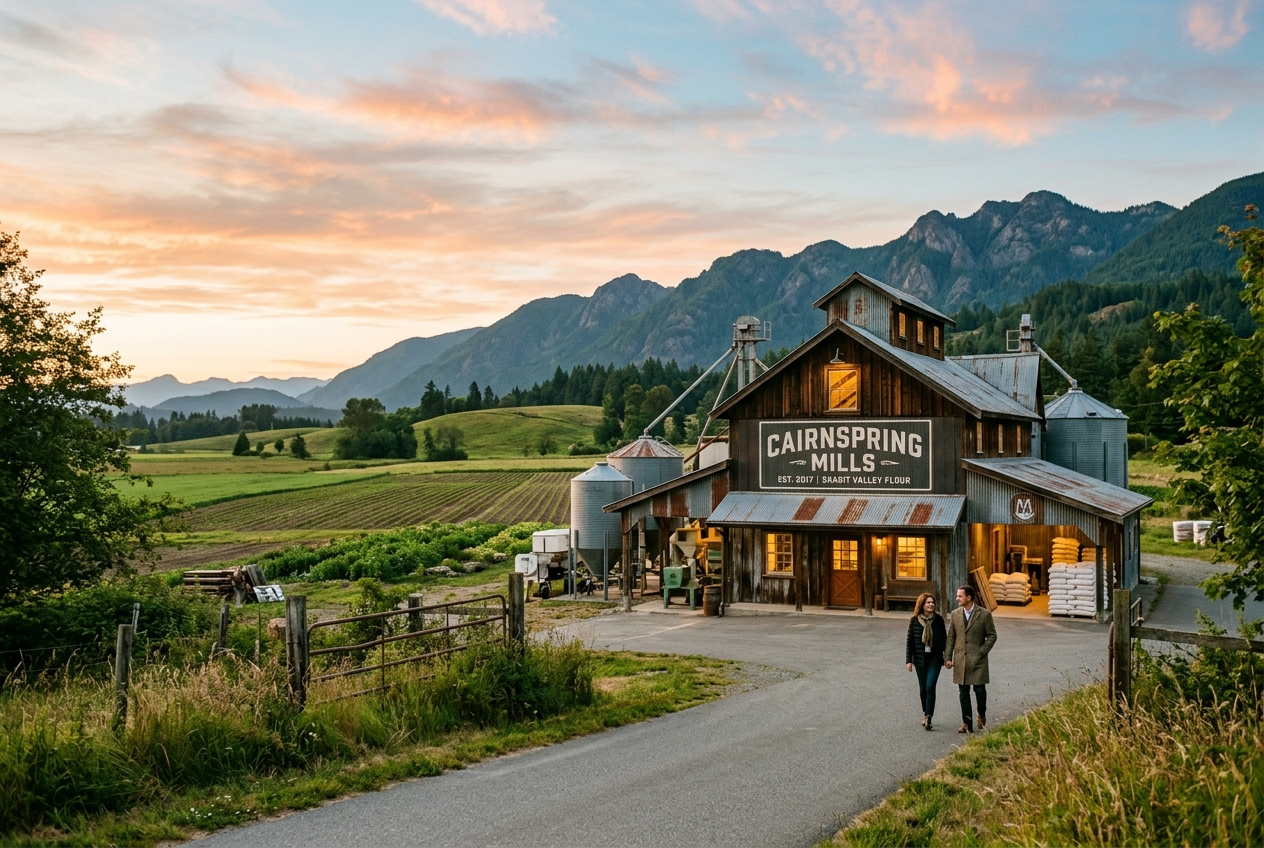
Cairnspring Mills is an established craft flour manufacturer with over a decade of operating history and more than $7 million in annual revenue from its existing mill north of Seattle, Washington. After reaching full production capacity at that facility, the company is now expanding with a second, larger mill: the Blue Mountain Mill, located in Eastern Oregon—strategically positioned on Interstate 84, one of the Pacific Northwest's primary east-west transportation corridors.
The Blue Mountain Mill is designed to increase Cairnspring's production capacity by approximately 10×. Construction began in Q3 2025 and is currently approximately 70% complete, with full completion expected in August 2026 and operations starting in Q4 2026.
This project offers investors eight distinct advantages that, together, place it well above the typical EB-5 offering:
All the benefits of rural EB-5 without the small rural real estate market risk
Repayment in as little as 3 years
Corporate repayment guarantee
Prior investment and due diligence by Peter Buffett's NoVo Foundation
Approximately 45% equity cushion below the EB-5 loan
Construction is already underway, with significant job creation already generated
Existing off-take agreements with nationally recognized food brands
Recession-resistant asset class—flour is an essential food product
All the Benefits of Rural EB-5 without the small rural real estate market risk
Projects located in rural Targeted Employment Areas (TEAs) come with two significant immigration advantages over standard EB-5 projects:
- ◆
Priority processing
- ◆
Reserved visa allocation
However, many rural EB-5 projects are tied to local real estate developments, such as hotels, residential schemes, or retail centers. The success of such projects depends entirely on the demand dynamics of a small local market. Cairnspring Mills is different. This is a national-scale manufacturing business serving customers across the United States. Its revenue doesn't depend on whether Eastern Oregon's local economy grows or contracts. You get the immigration speed of rural EB-5, without the geographic concentration risk that typically comes with it.
Tied to local real estate
Hotels, residential schemes, retail centers — success depends on a small local market.
National-scale manufacturer
Customers across the United States — revenue independent of Eastern Oregon's local economy.
Repayment in As Little As 3 Years
One of the most common frustrations investors have with EB-5 is the timeline. Many projects stretch repayment to 5, 7, or even more years. The Cairnspring Mills project is structured with a 3-year loan term, with the current plan being to refinance and exit EB-5 investors at that point. The projected EBITDA of approximately $10 million annually from the Blue Mountain Mill at full capacity supports a credible exit path through operational cash flow or refinancing.
Projected EBITDA at full capacity: ~$10M annually — supports refinancing or operational cash-flow exit.
Corporate Repayment Guaranteed
Most EB-5 investments are secured solely by the project asset, meaning that if the project underperforms, investors have limited recourse beyond the value of that single asset.
Cairnspring Mills adds a corporate repayment guarantee to the structure. The EB-5 loan is made to the parent company (backed by the parent's assets, cash flow, and existing operations), and then flows down to the Blue Mountain Mill in a junior position behind the bank.
Parent's assets, cash flow, and existing operations stand behind the loan obligation.
Project-level security in junior position behind the senior bank.
If the new mill faces headwinds, the parent's established operations stand behind repayment.
This creates a second layer of security that's genuinely uncommon in the EB-5 market. If the new mill faces headwinds, the parent company's established operations and assets stand behind the repayment obligation. For investors focused on capital preservation, this is one of the most important structural features of this deal.
Whatever your situation, book a completely free and confidential meeting today. High Net Worth Immigration brings 15+ years of experience helping clients secure second passports, residency, and cross-border asset protection.
Institutional Validation
In investment circles, the identity of co-investors matters. Not as branding, but as a signal of the due diligence that has already been completed.
The Cairnspring Mills project has already attracted capital and institutional scrutiny from Peter Buffett's NoVo Foundation and other blue-chip investors. That alone should provide some confidence before committing capital to this project. The NoVo Foundation has already completed a significant portion of the analytical work, and they have concluded that the company is worth backing. That is a strong signal for any investor conducting their own assessment.
Approximately 45% equity cushion below the EB-5 loan
One of the most important questions to ask about any EB-5 project is: how much equity sits below my loan? The more equity beneath the EB-5 layer, the greater the protection if things don't go to plan.
What this means: Equity holders absorb roughly 45% of project cost in losses before EB-5 capital is touched. Your loan sits well above the riskiest layer.
With roughly 45% of the Blue Mountain project cost contributed as equity sitting beneath the EB-5 loan, investors have a substantial cushion before their capital would be at risk. The EB-5 investors are not the primary risk capital in this deal—they're lending into a capital stack where the majority of the risk is carried by equity holders sitting below them.
Construction Already Underway
As you might know, early-stage EB-5 projects ask investors to take on construction risk. That's the possibility that a project doesn't get built, or doesn't get built on time. That risk pretty much doesn't exist here.
Construction of the Blue Mountain Mill started in Q3 2025 and is currently 70% complete, with full completion expected in Q3 2026. The project is also fully financed, meaning the capital to complete construction is already secured.
From an immigration standpoint, the job creation requirement is also well advanced. Over 100 direct and indirect jobs had already been created as of Q2 2026, out of a total projected ~560 jobs.
Secured Revenue Through Off-take Agreements
Many EB-5 projects in manufacturing or agriculture face demand risk—the question of whether customers will actually buy what the facility produces once it's running. Cairnspring has already answered that question.
The company has existing off-take agreements with nationally recognized brands. These are established, long-standing customer relationships built on Cairnspring's reputation for quality, consistency, and integrity.
Most of the Blue Mountain Mill's production capacity is already committed through these agreements before the facility has even opened.
Whatever your situation, book a completely free and confidential meeting today. High Net Worth Immigration brings 15+ years of experience helping clients secure second passports, residency, and cross-border asset protection.
Recession-resistant Asset Class
A second citizenship or permanent residency strategy should be stress-tested against a range of economic scenarios, not just the optimistic ones.
Flour is one of the most fundamental staple products in the global food supply. Demand for it does not collapse during a downturn. In fact, essential food products tend to hold up better than discretionary sectors when economic conditions tighten. Cairnspring operates in a non-cyclical, defensive industry with a structural demand base that is not going away.
Discretionary spending drops first when economic conditions tighten.
Essential staple — demand holds steady through any economic cycle.
Beyond the core staple argument, there is also a growth story. Cairnspring is positioned in the premium craft flour segment, with a mission anchored in regenerative agriculture and identity-preserved grains, both of which are areas where consumer demand is growing steadily as food brands and retailers respond to a more conscious buying public.
Investment At a Glance
Here's a quick summary of the key financial and immigration parameters for the Cairnspring Mills Rural EB-5 Project:
FAQs
Each investor contributes a minimum of $800,000, plus an $80,000 administrative fee. The project is open to 34 investors in total, for a total EB-5 capital raise of $27.2 million.
Yes. The current minimum investment for this rural EB-5 project is $800,000, plus the $80,000 administrative fee. However, the EB-5 minimum investment amount is expected to increase after December 31, 2026, with many industry insiders predicting a new TEA investment threshold of approximately $900,000.
Investors should also pay close attention to September 30, 2026, which is the more important grandfathering date. Investors who file before September 30, 2026, may be protected under the existing EB-5 framework, while investors who file after that date may be subject to future EB-5 policy changes.
34 investors for a total of $27.2 million in EB-5 capital.
The loan term is three years, with the option for up to two one-year extensions, meaning a maximum deployment period of five years. The developer must keep the EB-5 investment deployed for a minimum of three years. If the loan is not repaid after five years, EB-5 investors have the right to take over the project and enforce a sale.
0.25% per year, paid annually.
The current plan is to refinance after three years and exit the EB-5 investors; however, if the interest rate environment is not favorable at that time, the developer does have the option to extend the loan for up to a maximum of five years. The loan must be repaid after five years, or else the EB-5 investors have the ability to take over the project and enforce a sale.
The developer must deploy the EB-5 investment for a minimum of 3 years.
If your I-526E petition is denied for reasons unrelated to fraud or misrepresentation, you will receive a full refund of your $800,000 investment within 90 days.
Rural EB-5 projects benefit from priority processing. Current adjudication times average 6–12 months, with some cases approved in as little as 3 months. This is significantly faster than non-rural EB-5 projects.
Nearly 560 direct and indirect jobs from construction and operations.
Jobs are allocated on a first-in-first-out basis, meaning the first investor to have their I-526E petition approved receives credit for the first 10 qualifying jobs, the second investor for the next 10, and so on. Each investor requires a minimum of 10 jobs to satisfy the EB-5 requirement, and approximately 16.4 jobs are projected per investor, providing a meaningful buffer.
Construction started in Q3 of 2025 and will be completed in Q3 of 2026. Operations will begin in Q4 of 2026.
Ready to Explore This Opportunity?
The Cairnspring Mills Rural EB-5 Project is open to a limited pool of 34 accredited investors. With construction already well advanced and job creation underway, investors who move early benefit from the first-in-first-out job allocation structure. This means the earlier you file your I-526E, the stronger your position on job credit allocation. At High Net Worth Immigration, we work with internationally mobile investors to identify the right U.S. residency pathway for their specific profile. If you'd like to understand whether this project is the right fit for you or explore other EB-5 and U.S. immigration options, our team is here to help.