
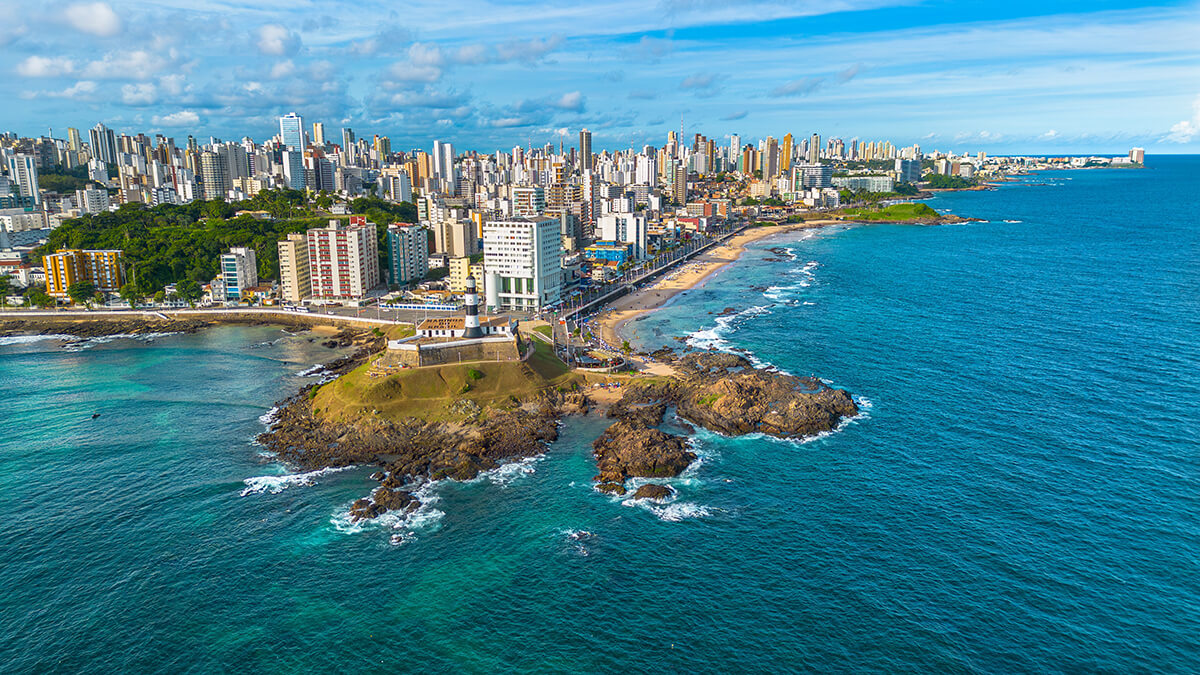
Most residency-by-investment programs make you choose between low cost and real returns. Brazil's Golden Visa does not force that trade-off. For roughly $200,000 in real estate, you get permanent residency in South America's largest economy, a credible path to a second passport, and an asset sitting in one of the world's fastest-appreciating property markets. That combination is rare in 2026.
This guide covers everything a sophisticated investor needs to evaluate and act on the Brazilian Golden Visa, officially called the VIPER (Visa de Residência Permanente por Investimento).
What Is the Brazilian Golden Visa (VIPER)?
The Brazilian Golden Visa is a residency-by-investment program administered by Brazil's National Immigration Council. Its official name, VIPER, translates to "Permanent Residency Visa by Investment." Despite not using the term "Golden Visa" in its official documentation, it functions identically to programs in Portugal, Greece, and the UAE: a qualifying investment in Brazil unlocks legal residency for you and your immediate family.
What sets VIPER apart from many of its global peers is that it offers two distinct pathways into the program and a relatively low physical presence requirement, making it genuinely workable for internationally mobile investors who do not plan to relocate full time.
The Two Investment Pathways in 2026
Pathway 1: Real Estate Investment
This is the most popular route, and the one most people associate with the Brazilian Golden Visa. The minimum capital requirements for 2026 are structured by geography:
Includes cities like São Paulo, Rio de Janeiro, and Florianópolis.
Includes states like Ceará, Bahia, and Pernambuco. A 30% discount — a deliberate government incentive to direct foreign capital toward regions the government is actively developing. These coastal northeastern markets have delivered some of the strongest rental yields in the country.
Is it possible to spread the investment across multiple properties? Yes. Brazilian immigration law allows aggregating multiple urban real estate purchases to reach the required threshold, giving investors the flexibility to diversify within the country while still qualifying for the program.
There are property rules that matter:
- ◆
The asset must be urban, not rural. Agricultural land is explicitly excluded.
- ◆
The property must have a formal deed registered with the Registro Geral do Imóvel (the Land Registry).
- ◆
Possession-only properties and off-plan units where the deed has not yet been issued do not qualify until the title is formally recorded.
- ◆
All investment funds must originate from outside Brazil and enter through authorized foreign exchange channels registered with Brazil's Central Bank.
Pathway 2: Business Investment
Investors who want an active foothold in the Brazilian economy, or who see the real estate market as less relevant to their goals, can qualify through a business investment instead.
Into a new or existing Brazilian company.
For investments in technology, innovation, or research-focused companies. This threshold also applies when the business plan includes creation of a minimum of 10 Brazilian jobs.
The business route requires a government-approved business plan demonstrating economic impact, registration with the Central Bank (RDE-IED), and fund transfer through authorized Brazilian banking channels. Brazilian immigration authorities scrutinize the business route more closely than the real estate route, so investors choosing this path should treat it as a genuine business decision, not just an immigration strategy.
Who Is Eligible to Apply?
Any foreign national, regardless of citizenship, can apply for the Brazilian Golden Visa provided they meet the investment requirements and clear the background check. Brazil does not impose country-of-origin restrictions on its VIPER program, which makes it accessible to investors from regions that face limited options elsewhere, including holders of passports from countries that are excluded from European Golden Visa programs.
No Country Restrictions
Brazil does not impose country-of-origin restrictions. Accessible to investors from regions excluded from European Golden Visa programs.
Family Included
Your spouse and dependents, including children of any age, can be added to the application. A single qualifying investment covers the entire immediate family unit.
One Threshold, All Members
Each family member does not need to meet a separate investment threshold. One investment qualifies the entire unit.
The Application Process, Step by Step
Understanding the mechanics removes ambiguity and helps you plan timelines accurately.
Obtain a Brazilian Tax ID (CPF)
Before you can execute a property transaction or open a Brazilian bank account, you need a CPF (Cadastro de Pessoas Físicas). Applications are submitted online through Brazil's Federal Revenue Service, with a mandatory consulate visit as part of the process. Issuance typically takes around 10 days from the consulate appointment.
Source and Acquire the Property or Make the Business Investment
For real estate investors, property due diligence through a qualified Brazilian attorney is non-negotiable. Title searches, encumbrance checks, and confirmation of urban zoning status must be completed before any funds change hands. Once the property transaction closes and the deed is registered, you have the documentary foundation of your application.
Transfer Funds Through Authorized Channels
All investment capital must enter Brazil through a recognized foreign exchange contract registered with the Central Bank of Brazil. This is not optional. The currency exchange contract itself becomes a required application document.
Submit the VIPER Application via MigrantWeb
Your Brazilian legal representative submits the formal VIPER application through MigrantWeb, the government's official immigration platform. Required documentation at this stage includes a valid passport, the registered property deed, the currency exchange contract, a clean criminal background check covering the past five years, an apostilled birth certificate, proof of income, proof of address, and the application fee receipt.
Approval and CRNM Issuance
Following successful verification, you receive a temporary residency permit valid for four years. Within 90 days of arriving in Brazil after visa issuance, you must register with the Federal Police to receive your CRNM, the official Brazilian ID card for foreign residents. This card enables you to open a bank account, apply for a driver's license, access public services, and operate within the Brazilian financial system.
Total processing time from application submission to visa issuance typically runs between four and six months, depending on consulate workload and document completeness.
What Does Brazilian Residency Actually Give You?
This is where many guides stay vague, but the practical benefits are specific and meaningful for an internationally active investor.
As a Brazilian resident, you have the legal right to live, work, and run a business in Brazil without additional permits. You can open Brazilian bank accounts, invest in local financial markets, access the national healthcare system (SUS), and enroll children in public schools and universities. Brazil's public university system, including institutions like USP (University of São Paulo), ranks among the top in Latin America.
From a business perspective, Brazilian residency gives you a legitimate, regulatory-recognized base in a USD 2-trillion-plus economy. For investors with interests across Latin America, that matters. Brazil shares borders with 10 countries and is a founding member of Mercosur, the South American trade bloc that facilitates significantly reduced trade barriers across Argentina, Paraguay, Uruguay, and several associate member states. Having Brazilian residency simplifies banking, company registration, and deal-making across the region.
Just 14 days in Brazil every two years. For global investors juggling multiple geographies, this is one of the least demanding physical presence requirements of any residency-by-investment program in the world.
The Path to Brazilian Citizenship and a Second Passport
A VIPER residency does not lead to citizenship automatically, but the timeline is structured and predictable.
VIPER approved — 4-year temporary residency permit issued
Maintain qualifying investment throughout — eligible to apply for permanent residency
Four years after PR — eligible to apply for Brazilian citizenship by naturalization
At the citizenship stage, applicants must pass a Portuguese language proficiency test and demonstrate a clean record. Brazil does not require renouncing your original nationality; dual citizenship is fully permitted under Brazilian law, which is a critical factor for investors who need to preserve their existing passport for travel, business, or tax reasons.
For investors asking whether there is a faster route: certain legal provisions may allow for an accelerated review when the investment substantially exceeds the minimum threshold or when other qualifying circumstances apply, but this is assessed case by case and should not be relied upon as a guaranteed shortcut.
How Strong Is the Brazilian Passport in 2026?
Global mobility is often the primary driver for high-net-worth investors pursuing second residency programs, so passport strength deserves a direct answer.
As of 2026, the Brazilian passport provides visa-free or visa-on-arrival access to approximately 170 destinations, including the entire Schengen Area, the United Kingdom, Japan, Singapore, South Korea, and the UAE. Brazil's passport has risen to its strongest position since 2019, driven partly by China's decision in mid-2025 to waive short-stay visas for Brazilian nationals.
For US investors in particular: a Brazilian passport simplifies access to 10-year B-1/B-2 nonimmigrant US visas for Brazilian-born family members and offers meaningful travel diversification as geopolitical conditions continue to affect bilateral relationships between the US and certain key markets.
The Real Estate Investment Opportunity
For investors approaching the Brazilian Golden Visa through the property route, the underlying asset performance is a legitimate part of the analysis, not just a residency mechanism.
Brazil's residential property market in 2025–2026 is showing differentiated performance across cities.
Driven by limited island supply, growing tech sector, and sustained international buyer demand.
Brazil's financial capital. Standard BRL 1,000,000 threshold applies.
Eligible for the reduced BRL 700,000 threshold. Ceará, Bahia, Pernambuco.
Rental yields in tourist-heavy coastal markets typically run between 0.5% and 1% of property value per month, with short-term rental platforms adding upside in high-traffic locations like Jurerê Internacional in Florianópolis or the established beachfront neighborhoods of Bahia.
Does the investment threshold change if exchange rates shift? The BRL thresholds (BRL 1,000,000 or BRL 700,000) are fixed in Brazilian Reais. The USD equivalent fluctuates with the exchange rate, which has historically meant the dollar cost of entry can decrease during periods of BRL depreciation. Investors with USD-denominated liquidity have often found BRL weakness an opportune entry point.
One critical note on off-plan properties: they qualify for the VIPER program only if the full capital transfer meets the threshold and the developer's legal documentation is properly structured. The deed must be formally issued and registered before the application can proceed. Engaging an experienced Brazilian real estate attorney before committing to any off-plan project is essential, not optional.
Brazilian Golden Visa vs. Other Programs in 2026
How does the Brazilian Golden Visa compare to competing programs for investors evaluating their options?
| Program | Route | Min. Investment | ~USD Equiv. |
|---|---|---|---|
| Brazil VIPER | Real estate | BRL 1,000,000 | ~$200,000 |
| Brazil VIPER | Business investment | BRL 500,000 | ~$100,000 |
| Spain | Real estate | EUR 500,000 | ~$550,000 |
| Greece | Real estate | EUR 250K–800K | ~$275K–$880K |
| Portugal | Fund / business (no RE route) | EUR 500,000 | ~$550,000 |
| UAE | Real estate | AED 2,000,000 | ~$545,000 |
Spain's Golden Visa real estate route requires a minimum EUR 500,000 investment (approximately USD 550,000), and the program has faced ongoing political discussion about its future viability. Greece's Golden Visa, while still active, requires EUR 250,000 to EUR 800,000 depending on the region and property type following 2023 threshold increases in high-demand areas. Portugal closed its real estate pathway entirely in 2023 and has shifted to fund-based and business routes.
The UAE Golden Visa requires a minimum AED 2,000,000 (approximately USD 545,000) in real estate. Dubai's property market is strong, but the entry cost is roughly three times the Brazilian equivalent.
Against those benchmarks, Brazil's VIPER at BRL 1,000,000 (approximately USD 200,000) for real estate, or BRL 500,000 (approximately USD 100,000) for business investment, sits in a different cost tier entirely. The trade-off is that Brazil does not offer the EU freedom of movement or the same wealth-management infrastructure that European programs provide. But for investors specifically targeting South American market access, a second passport with 170-destination reach, and a lower capital commitment, Brazil is competitive in a way that few alternatives match.
Total Costs: What to Budget Beyond the Investment
The investment threshold is only one part of the financial picture. Investors should budget for the following additional costs:
-
ITBI
The property transfer tax (ITBI) is typically 2% to 3% of the declared property value, paid at the time of purchase registration with the municipality.
-
Deed
Notary and registration fees for formalizing the deed are generally 1% to 1.5% of the property value.
-
Legal
Legal and consultancy fees for immigration attorneys and real estate advisors vary by firm and complexity but typically range from USD 5,000 to USD 15,000 for the full process.
-
Gov
The CPF application and MigrantWeb application submission involve nominal government fees.
Total all-in cost for a real estate-based VIPER application, beyond the investment itself, depending on property location, legal complexity, and the advisors engaged.
Documents Required for the Brazilian Golden Visa Application
Your legal representative will compile and submit the following:
Document requirements can be updated by Brazilian immigration authorities without advance notice. Confirming the current list with your legal representative before the submission is good practice.
Frequently Asked Questions
Yes. The investment holding requirement applies only during the four-year temporary residency period. Once you have converted to permanent residency, you are legally free to sell the property without affecting your residency status.
Selling or otherwise disposing of the qualifying investment before the four-year temporary residency period concludes may jeopardize your eligibility to convert to permanent residency. Replacing the investment with another qualifying asset is a possible remedy, but this should be handled carefully with legal guidance.
No. Portuguese proficiency is only required at the citizenship application stage, not for residency approval. However, having functional Portuguese will meaningfully improve your experience navigating the application process and living in Brazil.
Yes. VIPER holders have full work rights in Brazil, including the right to be employed, operate a business, and engage in commercial activity without additional work permits.
No. The requirement is a minimum of 14 days in Brazil within each two-year period. This is one of the lowest physical presence thresholds of any residency-by-investment program globally.
A Final Word on Timing
Brazil's real estate markets are appreciating, its passport continues to climb in global mobility rankings, and the VIPER program remains fully open and operational in 2026. European programs are tightening, closing, or raising thresholds. For a high-net-worth investor evaluating where to deploy capital for second residency, the window when Brazil offers this combination of low entry cost, strong asset appreciation, and a credible passport at the end of the journey may not stay this favorable indefinitely.
Getting the process right from the start requires qualified Brazilian legal representation. The program is straightforward in structure but exacting in documentation.
Evaluate Brazil's VIPER With an Expert
At roughly $200,000 for real estate or $100,000 for a business investment, Brazil's VIPER sits in a different cost tier to European programs — with 170-destination passport access, 14 days every two years presence, and an appreciating property market behind the investment. Whether it fits your broader residency and citizenship strategy is worth a structured conversation. Let's run the numbers honestly together.